

Hospital Infections by the Numbers
Why the Latest ECDC Survey Should Still Make Us Pause
Let's talk about the latest Point Prevalence Survey from the ECDC.
Yes, we know. Not exactly a page-turner. And probably not packed with surprises for most people working in healthcare. Still, it’s a useful reminder and there’s real value in having the key numbers laid out in one place.
Because when you step back and look at the bigger picture, the scale is hard to ignore.
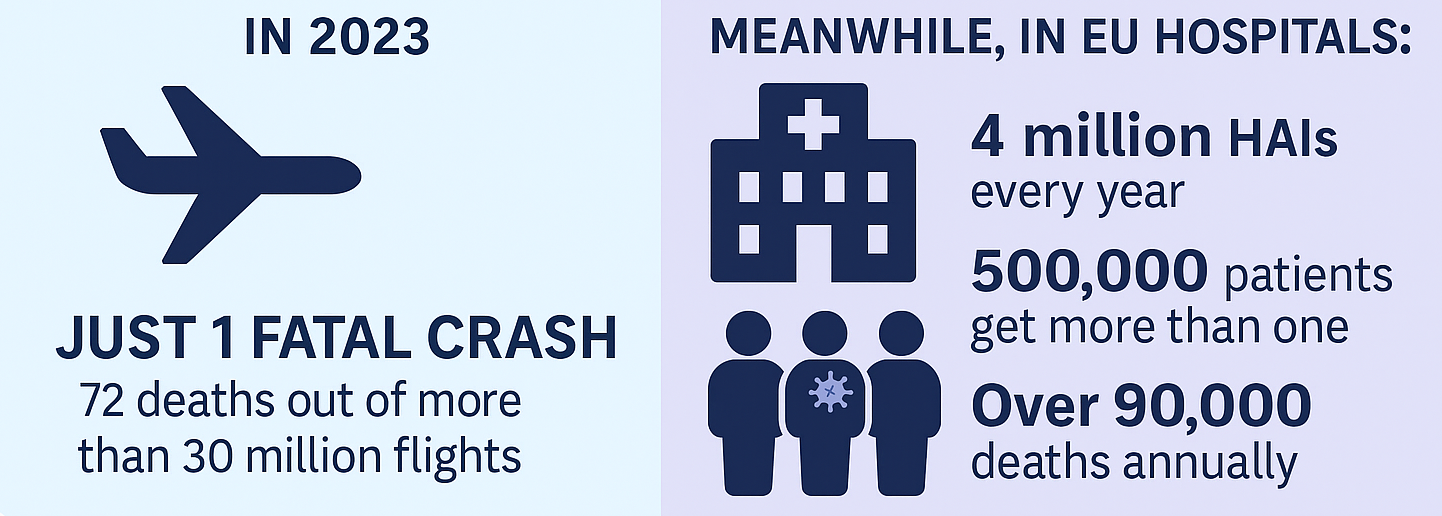
Put bluntly, if nothing changes, the EU loses the equivalent of a small country like Slovenia, Estonia, Malta, Iceland, Latvia… every 20 years to hospital infections.
And that’s the conservative estimate. Even the ECDC acknowledges that these numbers are likely too low. Many infections are never tested for, never detected, or never reported.
Comparing data between countries doesn’t help much either. The report itself practically says “don’t.” Different testing practices, varying reporting accuracy, and inconsistent data collection methods turn comparisons into apples and oranges and not even the good kind.
So what do we actually take away from the latest report, even though it’s already somewhat outdated?
It’s not perfect, but it’s a reasonable starting point. What it can’t replace is local reality. When it comes to actual infection risk, ward-level data and recent cases in your own hospital will always matter more. Still, some figures are impossible to ignore:
- In intensive care units, more than one in five patients (20.5%) had a healthcare-associated infection.
- And the usual suspects remain exactly that, reflected again in the WHO’s updated list of priority pathogens.

There’s a useful parallel here with aviation. We accept that accidents can happen, but the entire industry is built around systematic risk reduction and prevention. Layer upon layer of safeguards exist precisely because failure is not an acceptable default.
The same logic has to apply to infections.
We will never prevent every single infection. But we can and must prevent the preventable.


