

Pathogens To Watch
The Bacterial Priority Pathogens List
In 2024, the WHO released its updated Bacterial Priority Pathogens List. Think of it as a global watchlist for antimicrobial resistance. Making the list doesn’t earn trophies or red-carpet moments — it signals that a bacterium represents a serious and growing threat to global health.
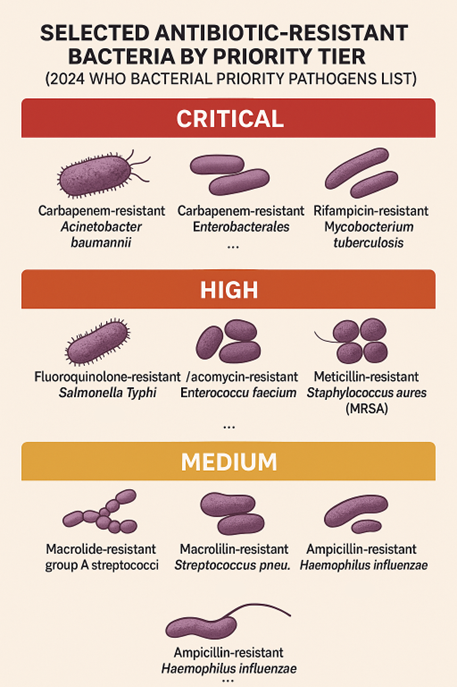
At the top sits the Critical priority tier, and once again, Gram-negative bacteria dominate the field. Carbapenem- and cephalosporin-resistant Enterobacterales, including Klebsiella species, continue to rank among the most concerning pathogens worldwide. Carbapenem-resistant Acinetobacter baumannii remains firmly entrenched, particularly in healthcare settings. Rifampicin-resistant Mycobacterium tuberculosis also holds its place, reflecting the ongoing global challenge of drug-resistant TB.
These rankings are not arbitrary.
The WHO uses a multi-criteria analysis that considers resistance trends, available treatment options, associated mortality, preventability, and the likelihood of transmission. In short, these organisms score highly because they are hard to treat, easy to spread, and capable of causing serious harm.
The High priority group brings no real surprises either. MRSA is still very much present. Vancomycin-resistant Enterococcus faecium continues to challenge infection control teams. Fluoroquinolone-resistant Shigella and Salmonella reflect rising resistance in common enteric pathogens, while cephalosporin-resistant Neisseria gonorrhoeae highlights growing concerns beyond the hospital setting.
There are also notable additions to the Medium priority tier. Penicillin-resistant Group B Streptococcus has gained attention due to its role in neonatal sepsis, reminding us that antimicrobial resistance is not confined to adult or critical care populations.
Why does this list matter? Because it is far from academic. It directly influences global research and development funding, surveillance priorities, and public health strategies. It also serves as a practical signal for where infection prevention efforts — hygiene, diagnostics, antimicrobial stewardship, and environmental controls — can have the greatest impact.
Perhaps the most unsettling detail is this: despite global attention, some of the pathogens on this list still have no promising treatments in the development pipeline.
The takeaway is straightforward.
Know the organisms you are most likely to face. Strengthen prevention wherever possible. And use this list as a starting point for real conversations within your team about risk, readiness, and response.
Because if you had to confront one of these pathogens head-on in your own ward, the best option is never having to face it at all.


